Badge
Jun 2, 2026
AI Revolutionizes Game Development and Player Experience
Artificial intelligence is no longer a futuristic concept in gaming but a present reality.
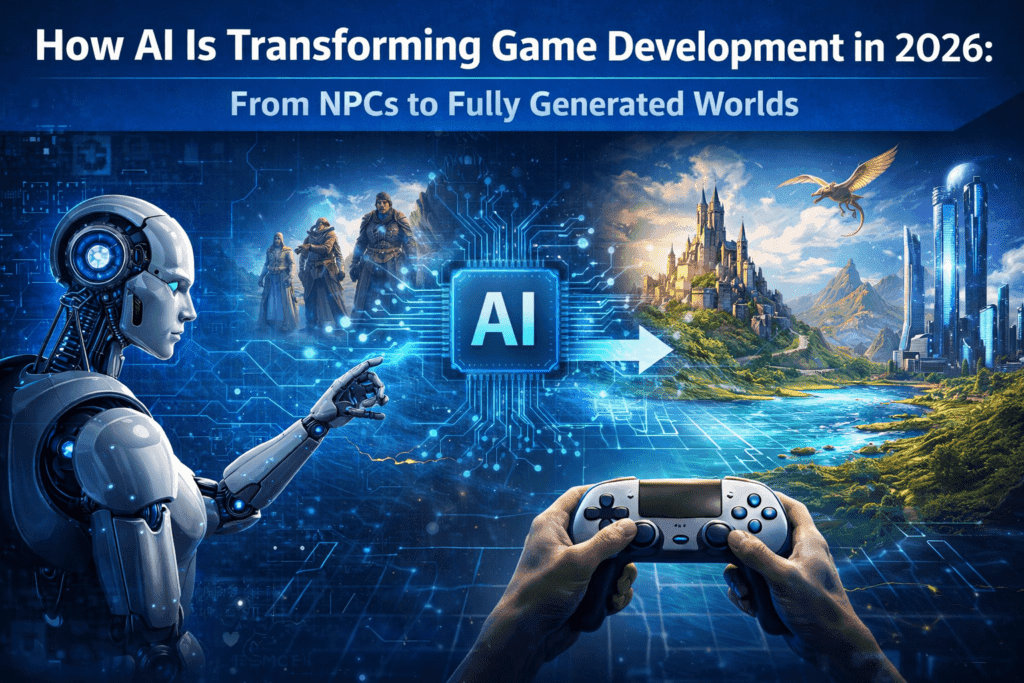
The video game industry has been fundamentally transformed by artificial intelligence (AI), with 2025 marking a pivotal year. As we navigate 2026, AI integration has moved beyond experimentation into full-scale production. A significant 50% of studios are now actively employing AI within their development pipelines, while an astounding 97% of developers utilize AI-assisted tools for tasks like asset creation. From the creation of intelligent non-player characters (NPCs) capable of genuine memory to the real-time generation of dynamic game worlds, AI is profoundly altering how games are conceived, built, and experienced by players.
AI's role in modern video games has evolved dramatically. It now serves as a foundational element in both game development and enhancing the player experience. On the gameplay front, AI is responsible for crafting realistic and responsive NPCs, generating dynamic and adaptive environments, elevating game graphics and visual effects, and delivering highly personalized experiences tailored to individual play styles. Simultaneously, it is revolutionizing the development process itself by streamlining workflows, automating asset generation, accelerating prototyping, and offloading labor-intensive tasks that previously consumed vast amounts of developer time.
The Game Developers Conference's 2025 State of the Game Industry report highlighted this shift, indicating that over half of game development companies now integrate AI into active production. This rapid adoption means that industry forecasts for AI's widespread use, previously projected for 2029-2034, have been realized by 2025. Consequently, AI now manages substantial portions of asset generation, procedural content creation, and quality assurance testing. This allows human developers to concentrate on their core strengths: creative direction, narrative design, emotional storytelling, and intricate systems architecture, leading to more ambitious, responsive, and rapidly produced games that retain their essential human creative spark.
The Evolved 2026 AI Gaming Landscape
The past eighteen months have solidified AI's position from a development curiosity to an indispensable production tool. The adoption rate has surged, with AI now integral to active production in half of all game studios, a dramatic increase from its nascent stages in early 2024. The Google Cloud Games Report further substantiates this, revealing that 97% of developers are employing AI tools for asset creation. The impact on digital marketplaces is also evident, with AI-disclosed titles constituting a significant portion of new releases on platforms like Steam, marking a substantial year-over-year increase.
Technological advancements have been equally crucial. On-device AI deployment has become the standard for achieving seamless, real-time gameplay, leveraging powerful local inference capabilities on modern GPUs and console hardware. The emergence of AI-native game engines, exemplified by prototypes demonstrating real-time video generation, hints at a future that could potentially redefine traditional rendering techniques. Furthermore, intelligent NPC systems now boast genuine memory retention, adaptive behaviors, and consistent personalities that persist across multiple play sessions, leading to more believable and engaging virtual companions.
The Promise and Peril of Generative AI
Generative AI, with its capacity to create novel content from existing data, holds immense potential for the gaming industry. However, its integration requires careful consideration. Many industry leaders believe generative AI will liberate creatives from repetitive, labor-intensive tasks, thereby accelerating content creation. Despite this efficiency, human creativity remains the indispensable core of what makes AI-influenced video games engaging and fun. Generative AI is not envisioned as a fully autonomous creator; human oversight, artistic direction, and iterative refinement are paramount.
Industry experts generally view generative AI not as a threat, but as a powerful new tool for designers and developers. While it may necessitate new roles and training, it unlocks exciting possibilities for both game development and the player experience. For instance, AI can assist in generating vast, detailed worlds and dynamic narrative branches, allowing developers to focus on the overarching vision and emotional resonance of the game.
Balancing AI with Human Ingenuity
A critical discussion revolves around striking the right balance between AI's rapidly expanding capabilities and the enduring value of human creativity. While AI can excel at generating content and optimizing processes, the nuanced art of emotional storytelling, artistic direction, and designing deeply resonant player experiences remains a human domain. The emergence of "gameslop"—a phenomenon characterized by low-quality, AI-generated titles—underscores the need for platform curation and established quality standards to ensure that AI enhances, rather than dilutes, the artistic integrity of games.
The Regulatory Horizon
Looking ahead, the increasing integration of AI necessitates the development of robust regulatory frameworks. These frameworks will need to address crucial aspects such as AI transparency in game development, the protection of intellectual property rights, and the safeguarding of player data. As AI continues to weave itself deeper into the fabric of gaming, these considerations will be vital for fostering a responsible and sustainable evolution of the industry, ensuring that innovation serves both creators and players ethically.
Source Insight: This report was curated based on original coverage from whimsygames.co.
Explore Kri-Zek
📱 Altered Brilliance App
Download on Google Play · Watch the Trailer
📖 The Power of Gaming
Watch the Video
🤝 Connect With Us
Kri-Zek on LinkedIn · Founder on LinkedIn · Happenstance
📸 Follow Us on Instagram
@krizekster · @krizek.tech · @krizekindia