Badge
May 1, 2026
Google DeepMind Unveils Project Genie AI for Interactive World Creation
Google DeepMind's Project Genie, an AI tool for generating interactive game worlds from text or images, is now accessible to select subscribers.
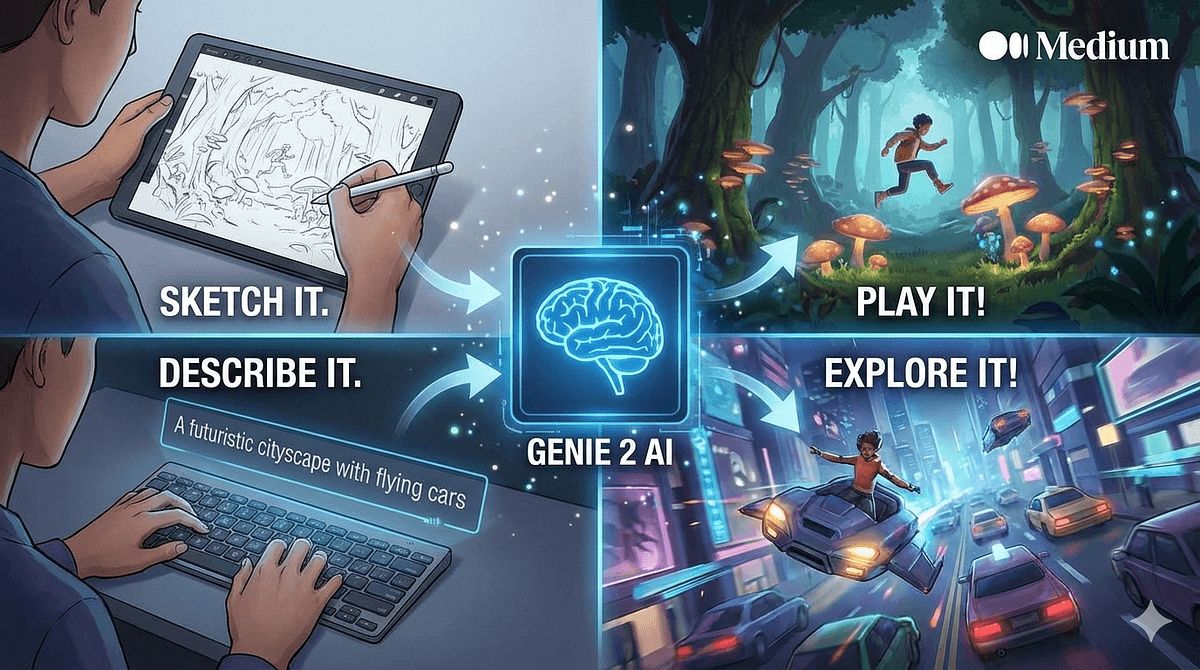
Google DeepMind has opened the doors to Project Genie, an experimental AI research prototype designed to generate interactive game worlds from simple text prompts or existing images. Initially available to Google AI Ultra subscribers in the U.S., this initiative represents a significant stride in the burgeoning field of world models, powered by the synergy of Google's advanced world model, Genie 3, its image generation model Nano Banana Pro, and the Gemini AI.
This release, following the research preview of Genie 3 just five months prior, signals DeepMind's strategic focus on gathering crucial user feedback and training data. The broader objective is to accelerate the development of more sophisticated world models, which many in the AI community, including those at DeepMind, consider a pivotal stepping stone towards achieving artificial general intelligence (AGI). In the nearer term, the envisioned go-to-market strategy leans heavily into the entertainment sector, particularly video games, with the ultimate goal of training embodied agents, or robots, within simulated environments.
Project Genie enters a rapidly intensifying race in the world model arena. Competitors are also making significant moves, with Fei-Fei Li’s World Labs releasing its commercial product Marble late last year. The AI video-generation startup Runway has also introduced its own world model, and AMI Labs, founded by former Meta chief scientist Yann LeCun, is similarly focused on this frontier.
Shlomi Fruchter, a research director at DeepMind, expressed palpable excitement about wider access, stating, “I think it’s exciting to be in a place where we can have more people access it and give us feedback.” Researchers acknowledge the experimental nature of Project Genie, highlighting its occasional inconsistencies. While it can impressively generate playable worlds, it sometimes produces unexpected or less relevant results, a common characteristic of cutting-edge AI research.
The user experience begins with a "world sketch." This involves providing text prompts that define both the environment and a main character. Users can then navigate these generated worlds from either a first- or third-person perspective. Nano Banana Pro generates an initial image based on these prompts, which can be modified before Genie leverages it as a foundation for an interactive experience. While these modifications are generally effective, the model can sometimes misinterpret requests, such as assigning purple hair when green was specified.
Project Genie also supports using real-life photographs as a basis for world creation, though this functionality, like prompt-based generation, can yield mixed results. Once the visual foundation is satisfactory, Project Genie takes only a few seconds to render an explorable world. Users can further engage by remixing existing worlds, exploring curated examples in a gallery, or utilizing a randomizer tool for inspiration. The current iteration allows for the download of short video clips showcasing the generated worlds.
DeepMind has implemented a 60-second limit for world generation and navigation, a constraint driven by budget and computational resources. As Genie 3 is an auto-regressive model, its operation demands significant dedicated compute power. "The reason we limit it to 60 seconds is because we wanted to bring it to more users," Fruchter explained, noting that a dedicated chip is assigned to each user session. Extending this duration would, in their view, diminish the incremental value derived from user testing.
The current environments, while interesting, exhibit some limitations in dynamism and interactivity due to their generative nature. However, DeepMind views these as challenges to be addressed and improved upon in future iterations. Notably, the platform incorporates safety guardrails, preventing the generation of explicit content or anything that infringes on copyrighted material, a pertinent consideration given recent legal challenges faced by AI companies regarding intellectual property.
The distinction between successful whimsical creations and less coherent realistic ones is apparent. While Project Genie excels at producing imaginative and engaging scenarios, its grasp on photorealistic detail or complex real-world physics appears less refined. This suggests that for now, its strengths lie in fostering creativity and exploration within fantastical or abstract digital realms.
Source Insight: This report was curated based on original coverage from techcrunch.com.
Explore Kri-Zek
📱 Altered Brilliance App
Download on Google Play · Watch the Trailer
📖 The Power of Gaming
Watch the Video
🤝 Connect With Us
Kri-Zek on LinkedIn · Founder on LinkedIn · Happenstance
📸 Follow Us on Instagram
@krizekster · @krizek.tech · @krizekindia