Badge
Jun 1, 2026
The AI Revolution in App Development
AI app builders are rapidly transforming software creation, enabling faster development cycles and democratizing access for creators. Discover the evolving landscape of AI-powered development tools.
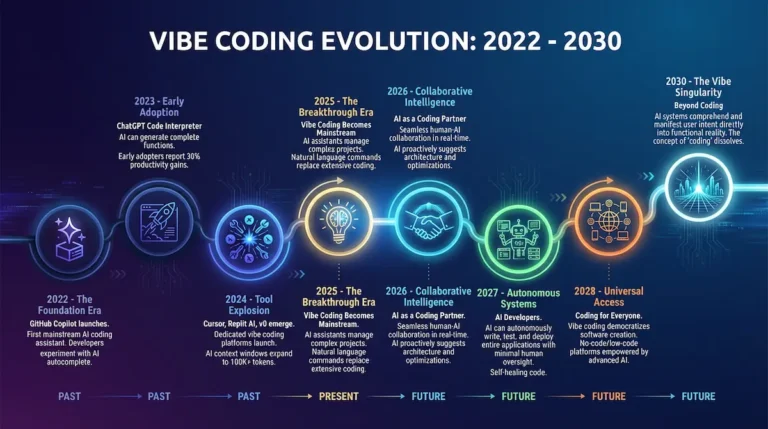
The landscape of software development is undergoing a profound transformation, with Artificial Intelligence emerging as a pivotal force. By 2026, AI app builders have transitioned from nascent concepts to essential tools, empowering a diverse range of users—from solo entrepreneurs to large enterprises—to conceptualize and construct functional software at unprecedented speeds. These platforms leverage advanced AI, including natural language processing and sophisticated code-generation models, to streamline the development process, translating human ideas into tangible applications with remarkable efficiency.
The global AI app development market is a testament to this burgeoning trend, projected to reach a staggering $221.9 billion by 2034, underscoring a significant compound annual growth rate of 18.6%. This growth signifies a broad adoption and increasing reliance on AI within the tech industry, making these tools crucial for anyone looking to innovate and compete.
Understanding AI App Builders
At their core, AI app builders utilize artificial intelligence to simplify and accelerate application creation. Users can articulate their vision through natural language, and the AI assists in generating key components such as dynamic user interfaces, robust database structures, and essential business logic. While a single prompt may not yet yield a fully deployable application, the ability of AI to drastically cut down the time from initial idea to a functional prototype—potentially from months to mere weeks—is a game-changer for product development cycles.
Categorizing AI App Builders
AI app builders can broadly be classified into two main categories, each catering to different user needs and technical proficiencies. Pure Code AI Builders are designed for developers who are comfortable with writing and editing code. These platforms expedite the generation of boilerplate code, allowing developers to retain complete control over the codebase and focus on intricate logic. Examples include Lovable, Bolt.new, and Cursor.
Conversely, No-Code / Low-Code AI Builders cater to individuals with less coding experience, enabling visual development often through drag-and-drop interfaces augmented by AI-generated elements. Platforms like WeWeb, FlutterFlow, and Softr are ideal for entrepreneurs, product teams, and designers aiming for rapid deployment without a steep learning curve. The choice between these categories hinges on individual technical expertise and project requirements, with both offering significant advantages in accelerating development.
The Broad Spectrum of Beneficiaries
The impact of AI app builders is far-reaching, democratizing the creation of digital products. Developers can leverage these tools to accelerate the generation of production-ready code, freeing up time to concentrate on complex architectural challenges and innovative solutions. Startups can efficiently build and validate Minimum Viable Products (MVPs) with limited resources, enabling faster iteration and market testing. Enterprises can empower internal teams to develop custom internal tools securely and efficiently, while creators and solopreneurs can bring their app ideas to life without the need for extensive development teams or capital.
The Imperative of Embracing AI App Builders
AI app builders are not replacements for human developers but rather powerful augmenters. Their primary benefits lie in unparalleled speed and efficiency, enabling concepts to transform into functional prototypes within hours, thus facilitating quicker market entry. Furthermore, they offer significant cost-effectiveness, drastically reducing early-stage development expenses and reallocating resources towards critical areas like marketing and user acquisition.
The capacity for iterative development is another key advantage, allowing for rapid deployment, swift collection of user feedback, and real-time refinement of user interfaces and logic. Finally, the accessibility offered by AI tools lowers the barrier to entry, empowering a wider range of individuals to create meaningful and functional applications, thereby fostering broader innovation across industries. The ability to rapidly prototype and iterate, often demonstrated through impressive turnarounds like a complete job tracker redesign in just 24 hours, showcases the transformative potential of these technologies.
Source Insight: This report was curated based on original coverage from weweb.io.
Explore Kri-Zek
📱 Altered Brilliance App
Download on Google Play · Watch the Trailer
📖 The Power of Gaming
Watch the Video
🤝 Connect With Us
Kri-Zek on LinkedIn · Founder on LinkedIn · Happenstance
📸 Follow Us on Instagram
@krizekster · @krizek.tech · @krizekindia