Badge
Jun 4, 2026
The AI Revolution in Coding: Navigating the Rise of Vibe Coding
Vibe coding, powered by AI, is rapidly transforming software development. Discover its impact on speed, cost, and the evolving role of developers.
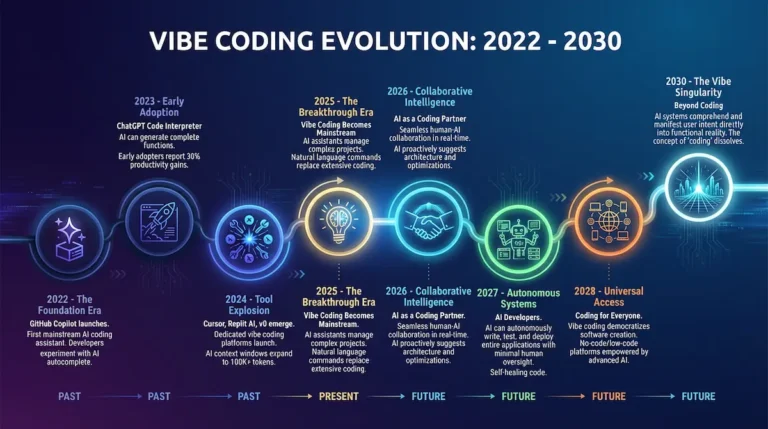
The Dawn of AI-Augmented Development
Vibe coding has surged from a niche concept to a dominant force in software development, officially recognized and embraced globally. By 2026, with a staggering 41% of all code being AI-generated and 92% of US developers actively using AI coding tools, understanding this paradigm is no longer a competitive advantage—it's a necessity for business survival.
Defining the "Vibe" in Coding
Coined by Andrej Karpathy, a luminary in AI, vibe coding is a paradigm shift where developers leverage Large Language Models (LLMs) to generate code through natural language prompts. Instead of meticulous line-by-line manual creation, developers act as orchestrators, guiding AI assistants to handle implementation details. This approach allows for an unprecedented focus on high-level logic and creative problem-solving, with the AI taking on the task of writing, debugging, and refining code at remarkable speeds.
A New Era of Development Speed and Efficiency
The transformation is stark when compared to traditional coding methods. Vibe coding replaces manual coding with AI-driven generation via prompts, shifting the developer's role from writer to director. This accelerates the workflow dramatically, reducing feature development from days to minutes and enabling rapid iteration cycles of prompt, review, refine, and deploy. The skills required also evolve, emphasizing clear problem description and robust review capabilities over deep, granular language expertise.
Market Dynamics: AI's Unprecedented Growth
The adoption statistics paint a clear picture of AI's impact. The daily usage of AI coding tools by US developers stands at 92%, with AI contributing to 41% of global code output. Projections suggest a 300% increase in coding speed and Gartner's forecast of 40% of enterprise software being developed via vibe coding by 2028 highlights the industry's trajectory. Milestones like Y Combinator startups heavily relying on AI and the exponential valuation growth of companies like Cursor underscore this rapid ascendance.
Navigating the Advantages and Pitfalls
The benefits of vibe coding are compelling: dramatic speed increases, reduced development costs, and the democratization of development, allowing non-programmers to contribute. It enables rapid prototyping and frees developers from boilerplate tasks. However, significant challenges exist. Studies indicate AI-generated code is more prone to security vulnerabilities (40% higher likelihood) and can lead to rapid accumulation of technical debt, impacting ROI and maintenance budgets. Governance also becomes more complex, making it harder to track code origins and ensure compliance, especially in regulated sectors.
The "Vibe Coding Hangover" and Quality Concerns
Concerns have emerged around code quality and developer skill erosion. The rapid pace can result in fragmented, undocumented code that is difficult to maintain. Some reports highlight a decline in fundamental programming skills among junior developers, while senior engineers grapple with the debugging burden of AI-generated code, a phenomenon dubbed the "vibe coding hangover." This emphasizes the critical need for robust governance and quality frameworks.
Top Tools Shaping the Vibe Coding Landscape
Several platforms are at the forefront of this revolution. Tools like Cursor, Windsurf, Replit Agent, and Claude Code offer distinct capabilities for AI-assisted development. These platforms are not just code generators; they are evolving into comprehensive development environments that streamline the entire workflow, from initial prompting to code refinement and debugging, enabling developers to harness AI's potential effectively.
Strategic Implementation and the Road Ahead
For businesses to effectively leverage vibe coding, a strategic approach is essential. This involves comprehensive readiness assessments, careful tool selection and integration, and establishing strong governance and quality frameworks. Upskilling teams, managing the cultural shift, and adopting hybrid development models are crucial. An implementation roadmap typically begins with internal tools, progresses to establishing governance, training teams, piloting customer-facing projects, and finally, scaling and optimizing the process.
The Future Vision: Self-Healing Software and Agentic Development
Looking beyond 2026, the future of vibe coding promises even more sophisticated advancements. Concepts like self-healing software, where AI can autonomously detect and fix bugs, and agentic development, where AI agents manage entire development cycles, are on the horizon. The role of developers will continue to evolve, focusing on higher-level system design, ethical considerations, and complex problem-solving, becoming true architects of AI-driven creation.
Conclusion: Embracing the Vibe
Vibe coding represents a fundamental shift, offering immense potential for innovation and efficiency. While challenges related to security, technical debt, and code quality are real, proactive strategies, robust governance, and a focus on continuous learning can mitigate these risks. The question for businesses in 2026 is not if they should adopt vibe coding, but how they can best harness its power to remain competitive and drive future success.
Source Insight: This report was curated based on original coverage from tizbi.com.
Explore Kri-Zek
📱 Altered Brilliance App
Download on Google Play · Watch the Trailer
📖 The Power of Gaming
Watch the Video
🤝 Connect With Us
Kri-Zek on LinkedIn · Founder on LinkedIn · Happenstance
📸 Follow Us on Instagram
@krizekster · @krizek.tech · @krizekindia