Badge
Aug 4, 2026
The Dawn of Sentient Worlds: AI's Transformative Impact on Gaming Immersion
Artificial Intelligence is no longer a peripheral tool in video games; it's a fundamental architectural pillar reshaping how we interact with virtual worlds.
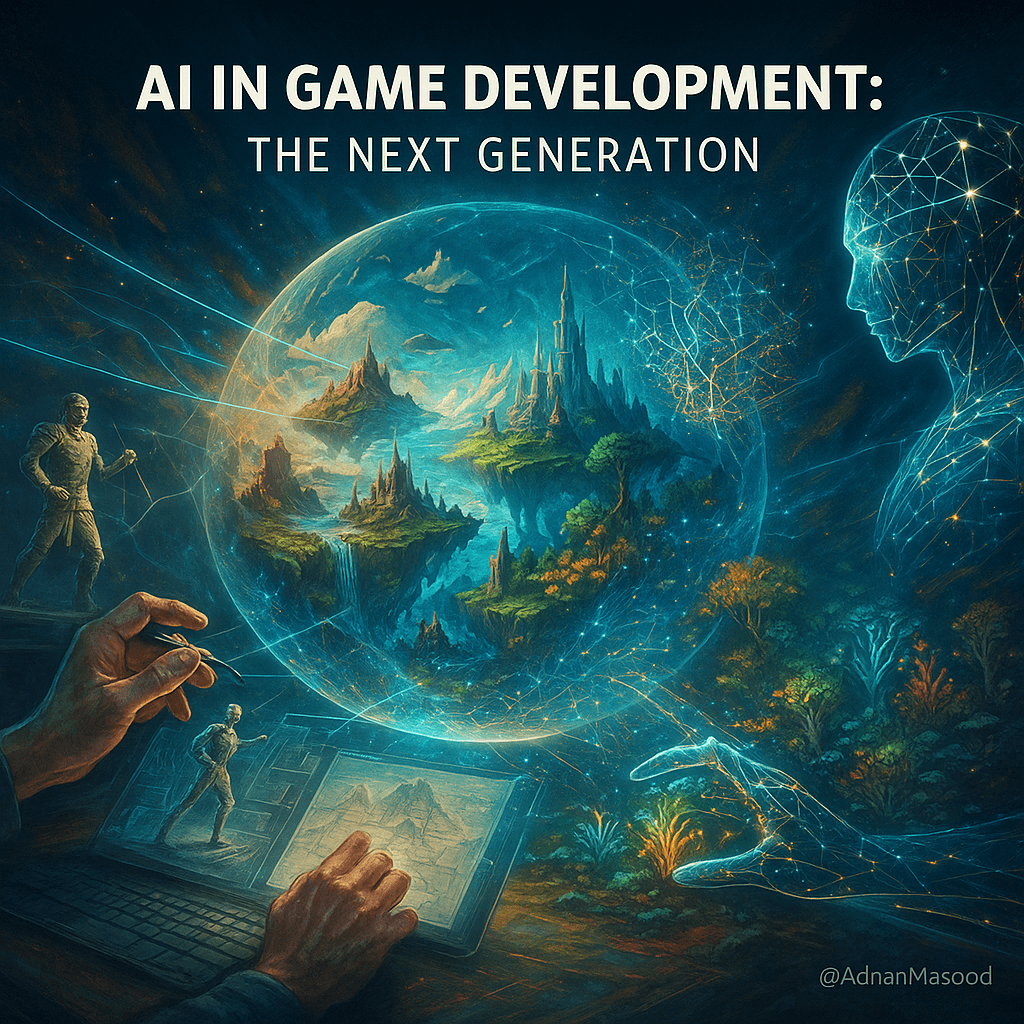
The video game industry stands on the precipice of a profound transformation, propelled by the relentless integration of Artificial Intelligence. What was once considered a supplementary tool has now emerged as a core architectural component, redefining the very fabric of game design, development, and the player experience itself. Valued at approximately $3.28 billion for AI-specific applications in 2024, this sector is projected to surge past $51 billion by 2033, reflecting an astonishing compound annual growth rate of 36.1%. This explosive trajectory is not merely a statistical anomaly but a testament to AI's power to unlock unprecedented possibilities within virtual realms.
Evolving NPC Intelligence: Beyond Scripted Responses
Historically, Non-Player Characters (NPCs) were confined to rigid finite state machines and predictable, often immersion-breaking, scripted decision trees. Their behaviors were deterministic: patrol a fixed path, utter a canned response, and repeat. However, the advent of deep reinforcement learning, transformer-based language models, and real-time neural inference has shattered these limitations. Modern AI-NPC architectures are now multi-layered, encompassing a perception layer to process environmental and player states, a reasoning layer for planning and decision-making, and an expression layer for dialogue and animation. This sophisticated framework allows NPCs to reason, remember, adapt, and surprise, capabilities that were mere research concepts just a few years ago but are now becoming commonplace in commercial titles.
The Rise of Conversational Characters
One of the most transformative advancements is the integration of Large Language Models (LLMs), enabling a qualitatively new mode of NPC interaction: open-ended natural language dialogue. NPCs are no longer limited to pre-selected dialogue options; instead, they generate contextually appropriate replies in real-time, conditioned by their personality, relationship history with the player, and the current world state. Initiatives like Ubisoft NEO NPC demonstrate this in open-world environments, where characters can answer unscripted questions and provide dynamically generated quest directions. Similarly, Inworld AI, integrated with major game engines like Unity and Unreal Engine, takes this further by incorporating voice synthesis, emotional state modeling, and evolving personality traits that adapt as players progress through the narrative.
The Power of Procedural Memory
A critical enabler for truly dynamic NPC interactions is Procedural Dialogue Memory (PDM). These systems store and retrieve vital interaction metadata—past choices, faction reputations, completed objectives—to condition future NPC responses. This means each playthrough becomes a uniquely personalized narrative, with characters referencing specific past events rather than treating every interaction as stateless. Advanced architectures, such as those employed by Jenova AI, utilize persistent external storage, transcending the limitations of context windows and allowing for the simulation of genuine, long-term relationships across unlimited gaming sessions. This moves beyond simple recall to a more sophisticated form of simulated consciousness within the game world.
Adaptive Combat and Dynamic Personalities
Beyond dialogue, Reinforcement Learning (RL) has revolutionized NPC combat intelligence. Studies utilizing techniques like Proximal Policy Optimization (PPO) have shown that RL-trained NPCs exhibit significantly superior responsiveness, adaptiveness, and dynamic challenge scaling compared to their rule-based predecessors. The training, conducted offline across various difficulty tiers, results in modular runtime components that seamlessly integrate into game engines. The iconic Nemesis System from Middle-earth: Shadow of Mordor remains a seminal example, where enemies remember past encounters, gain rank, develop unique personality traits, and return with modified tactics. Newer titles are expanding this paradigm, allowing NPCs to form social relationships with each other and coordinate emergent strategies, fostering a truly dynamic and unpredictable combat environment.
Dynamic Environments and Personalization
AI's influence extends beyond intelligent characters to encompass the very environments players inhabit. AI-driven dynamic environment generation leverages Procedural Content Generation (PCG) and adaptive world-building systems to create landscapes and scenarios that evolve in real-time. This not only offers immense replayability but also allows for game worlds that react organically to player actions. Furthermore, player-centric gameplay enhancement is achieved through Dynamic Difficulty Adjustment (DDA), personalization engines, and generative AI-assisted narrative systems. These technologies tailor the game experience to individual player skill levels and preferences, ensuring a constantly engaging and appropriately challenging journey.
Technical Architectures and Industry Deployments
The advancements are supported by sophisticated technical architectures. Leading industry deployments, including Ubisoft NEO NPC, NVIDIA ACE, Inworld AI, and the aforementioned Nemesis System, are at the forefront of this revolution. Data from the GDC 2025 State of the Game Industry Report consistently highlights the increasing adoption and reliance on these AI frameworks. The transition from prototype to production, however, presents challenges, including the need for efficient real-time inference, ethical considerations in content generation, and maintaining long-term NPC memory consistency.
The Future of Interactive Storytelling
In conclusion, AI in gaming has transcended its role as a mere supplementary tool to become a fundamental architectural pillar. It is profoundly redefining player immersion, streamlining developer workflows, and expanding the very boundaries of interactive storytelling. As AI continues to evolve, we can anticipate game worlds that are not just vast but sentient, where every interaction is meaningful, every character feels alive, and every story is uniquely woven around the player's journey. The future promises a gaming landscape where the line between the virtual and the truly intelligent blurs, offering experiences of unprecedented depth and personal connection.
Source Insight: This report was curated based on original coverage from ijarsct.co.in.
Explore Kri-Zek
📱 Altered Brilliance App
Download on Google Play · Watch the Trailer
📖 The Power of Gaming
Watch the Video
🤝 Connect With Us
Kri-Zek on LinkedIn · Founder on LinkedIn · Happenstance
📸 Follow Us on Instagram
@krizekster · @krizek.tech · @krizekindia