Badge
Jun 26, 2026
The Quantum Shift: Vibe Coding and the Future of Software Development
Explore 'vibe coding,' the revolutionary AI-powered approach transforming software creation.
In an era defined by accelerating technological innovation, a revolutionary paradigm has taken hold in the software development landscape: vibe coding. Coined in early 2025 by Andrej Karpathy, a luminary in machine learning and co-founder of OpenAI, this term swiftly permeated the industry, becoming Collins Dictionary’s Word of the Year by November 2025. Vibe coding signifies a fundamental reorientation in how software is conceptualized and built, leveraging artificial intelligence to translate human intent directly into functional code.
Understanding Vibe Coding's Essence
At its core, vibe coding is an AI-assisted development methodology where a developer articulates their desired outcomes in natural, conversational language, and a large language model (LLM) takes on the task of generating the actual source code. This eliminates the necessity of meticulous, line-by-line manual coding, shifting the developer's role from syntax construction to strategic direction and nuanced refinement. Karpathy's initial description on X highlighted this profound shift: "There’s a new kind of coding I call ‘vibe coding’, where you fully give in to the vibes, embrace exponentials, and forget that the code even exists."
The Mechanics of Intent-Driven Development
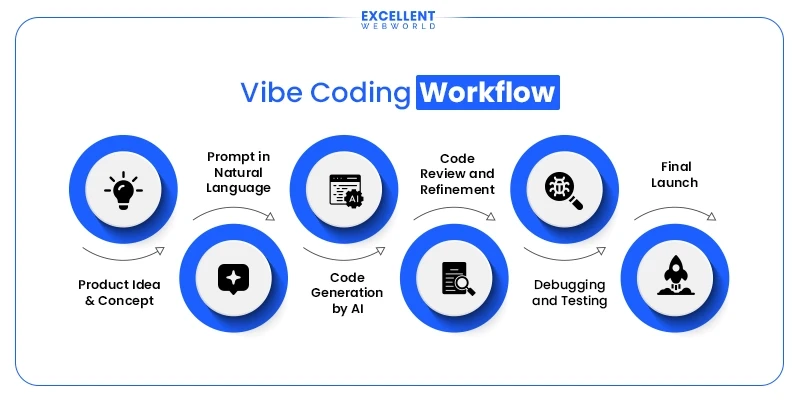
Transitioning from concept to practice, vibe coding operates on an iterative four-step loop: describe, generate, review, and refine. The process begins with a clear, natural language prompt detailing the desired application, feature, or UI component. The AI, powered by advanced LLMs, then generates comprehensive and functional code—extending beyond mere snippets to encompass entire components, database schemas, and user interface layouts. The developer's focus during the review phase is on the functionality and alignment of the output with their vision, rather than granular code inspection. Subsequent refinement occurs through conversational prompts, allowing for rapid iterations and precise adjustments until the desired outcome is achieved. This streamlined cycle enables prototyping and deployment in mere minutes, a stark contrast to traditional development timelines.
A Divergence from Traditional Paradigms
Traditional software development demands comprehensive expertise in programming languages, frameworks, and intricate tooling. Every line is written, every bug debugged, every dependency managed manually. Vibe coding, conversely, abstracts much of this complexity. While it still necessitates critical judgment, aesthetic sensibility, and the ability to articulate precise requirements, it significantly lowers the barrier to entry by reducing the need for deep syntactical knowledge. As Simon Willison, co-creator of Django, aptly noted, true vibe coding is characterized by the willingness to accept AI-generated code without needing exhaustive comprehension of every line, prioritizing speed and accessibility over exhaustive code-level understanding.
The Explosive Growth of an Industry Standard
The trajectory of vibe coding has been nothing short of meteoric. Statistics underscore its pervasive adoption: 92% of US developers now use AI coding tools daily, and AI-generated code accounts for 41% of global codebases. A quarter of Y Combinator's Winter 2025 cohort featured codebases that were 95% AI-generated, a testament to its efficacy even among highly technical founders. This phenomenon isn't about replacing skill but amplifying it, allowing developers to achieve unprecedented velocity and scope in their projects. Analysts project that by the end of 2026, AI-generated code will constitute 60% of all code, while the vibe coding market itself reached an estimated $2.96 billion in 2025, with 87% of Fortune 500 companies integrating these platforms.
The Ecosystem of Vibe Coding Tools
The burgeoning ecosystem of vibe coding tools reflects its versatility and widespread adoption. Platforms like AIDesigner are revolutionizing UI design and website creation, allowing users to generate production-ready interfaces and live websites from natural language prompts. Other tools like Cursor and Windsurf enhance professional code editing through AI-driven context and prompts, facilitating complex code changes and refactors. For full-stack application development, Bolt.new and Lovable enable the generation of complete web and mobile applications, often with integrated UI design capabilities, purely through conversational input. Even command-line interfaces are seeing transformation with tools like Claude Code, while established players like GitHub Copilot offer inline code completion and suggestions that integrate seamlessly into existing workflows. These tools collectively empower creators to manifest their visions with unprecedented efficiency, democratizing access to software creation while simultaneously accelerating expert developers.
Design-Centric Vibe Coding with AIDesigner
Among the leading tools, AIDesigner stands out for its focus on the design dimension of vibe coding. It empowers users to generate sophisticated user interfaces and entire websites by simply describing their aesthetic and functional requirements. This approach bridges the gap between design intent and executable code, allowing designers and developers to iterate rapidly on visual concepts and deploy them with minimal manual coding. The tool emphasizes a seamless workflow, moving from conceptualization to a tangible, interactive product almost instantaneously, embodying the efficiency and creative freedom that vibe coding promises.
The Broader Implications for Gaming and Interactive Media
The impact of vibe coding extends profoundly into the creative industries, including gaming and interactive media. Game developers can now rapidly prototype mechanics, build complex UI/UX elements, and even generate entire environments or character behaviors through descriptive prompts. This capability dramatically reduces iterative cycles, allowing creators to spend more time on artistic vision and less on boilerplate coding. The ability to quickly experiment with different concepts and receive immediate, functional outputs opens new avenues for innovation, potentially leading to more diverse, engaging, and rapidly developed gaming experiences. The enhanced accessibility also means smaller studios and independent creators can bring ambitious projects to life, leveling the playing field and enriching the overall digital entertainment landscape.
The Ongoing Evolution and Future Outlook
Vibe coding is not merely a trend; it represents a fundamental shift in the relationship between humans and technology in the creative process. As AI models become increasingly sophisticated and adept at understanding nuanced human input, the capabilities of vibe coding will only expand. This evolution promises to further blur the lines between ideation and execution, empowering a new generation of creators to build complex digital products with unprecedented ease and speed. The future of software development, driven by the principles of vibe coding, will likely be more intuitive, more accessible, and profoundly more dynamic, transforming the very definition of what it means to be a 'developer' in the digital age.
Source Insight: This report was curated based on original coverage from aidesigner.ai.
Explore Kri-Zek
📱 Altered Brilliance App
Download on Google Play · Watch the Trailer
📖 The Power of Gaming
Watch the Video
🤝 Connect With Us
Kri-Zek on LinkedIn · Founder on LinkedIn · Happenstance
📸 Follow Us on Instagram
@krizekster · @krizek.tech · @krizekindia